Much like the pyramids of old, modern translation industry is vast and cryptic and finding the right language service provider can sometimes feel like monumental task. As someone who has spent years immersed in this world, I’m here to shed light on a crucial aspect often overlooked — the dynamics of outsourcing. Buckle up and let’s explore the intricacies of the translation pyramid, it’s impact on quality, the industry and why your investment deserves better.
(This is a re-publication of the material that has been previously published on my LinkedIn).
The Pyramid Paradox: Decoding the Industry Structure
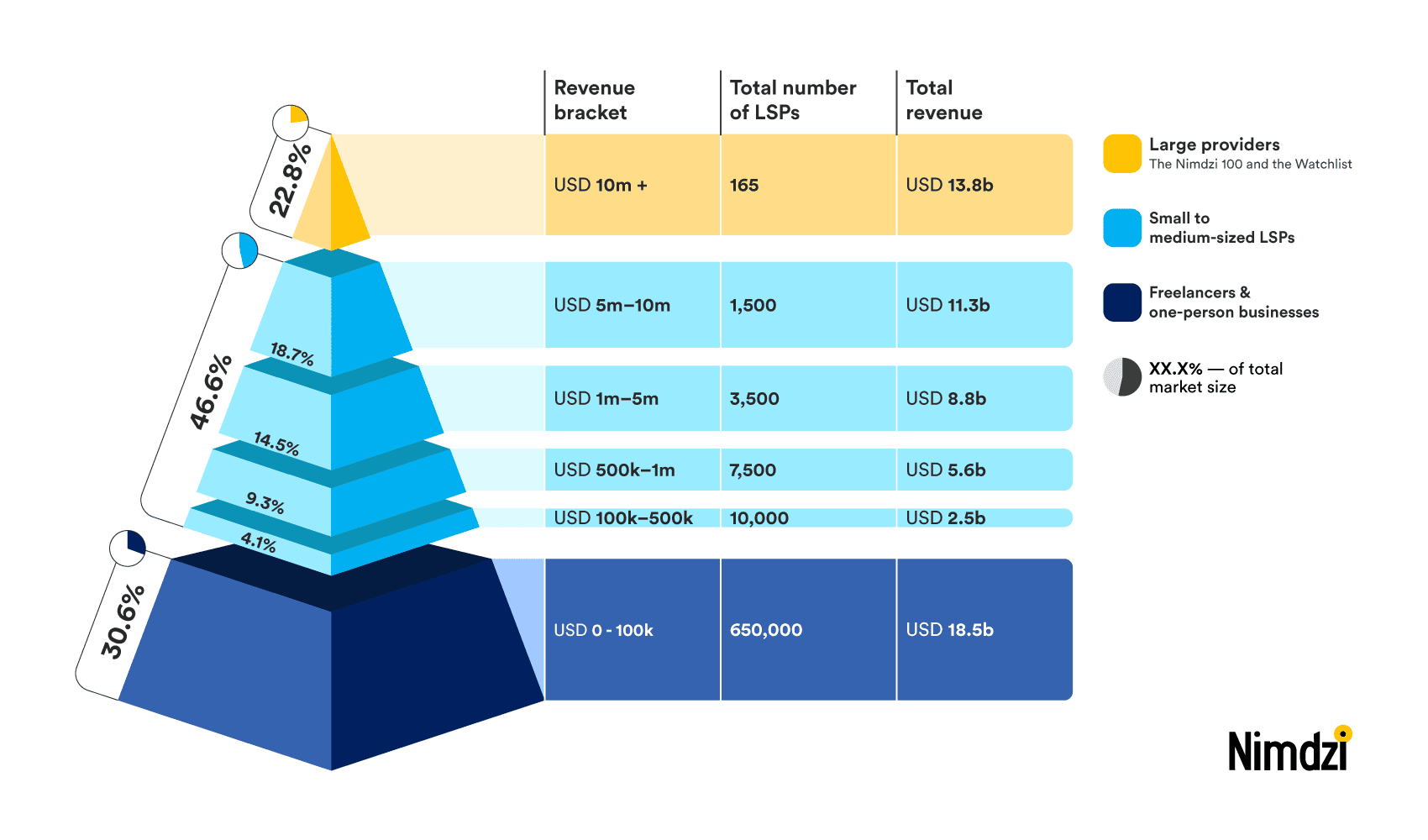
Somewhere around 2023, Nimdzi Insights unveiled a fascinating pyramid illustrating the players in the language industry by revenue. Picture it from top to bottom — large providers, small to medium-sized LSPs, and freelancers. What this pyramid didn’t explicitly mention, but I can vouch for through personal experience, is the outsourcing reality at the top.
Surprisingly, the top layers, including large providers and medium-sized LSPs, often outsource nearly 100% of the actual translation, proofreading, and interpreting to freelancers and the small boutique agencies at the bottom layer. Unless those big players have interns with some spare time, it’s the freelancers who bring life to the words, not the towering layers above.
Quality vs. Revenue: The Dilemma of Price-Driven Competition
The revenue of LSPs, regardless of size, encompasses the earnings of freelancers at the bottom. Here’s where it gets interesting — in the fierce competition between LSPs, often dictated by price, the discount to clients is deducted from the fees paid to freelancers and small agencies. And unfortunately, many freelancers are compelled to accept whatever pay is offered and those who are more experienced and charge more are simply pushed out of the market
Now, as you probably already see quality doesn’t necessarily follow the money. The winning LSPs, tend to drive out the best-qualified and experienced freelancers and small boutique agencies with their dumping tactics. It’s a cycle that compromises professionalism rather than elevating it.
QUALITY DOESN’T FOLLOW THE MONEY. THE WINNING LSPS, TEND TO DRIVE OUT THE BEST-QUALIFIED AND EXPERIENCED FREELANCERS AND SMALL BOUTIQUE AGENCIES WITH THEIR DUMPING TACTICS. IT’S A CYCLE THAT COMPROMISES PROFESSIONALISM RATHER THAN ELEVATING IT.
The Unspoken Reality: Greed, Exploitation, or Strategy?
In my journey through the translation industry, I had already resigned myself to the fact that few acknowledge the reality, a truth grounded in my personal experience. Our profession often finds itself at the lowest layer of the pyramid, a layer with the lowest entry hurdles, making it surprisingly easy for individuals to set up shop without the proper qualifications. What’s often overlooked is that the layers above, including the towering LSPs, function primarily as brokers for the services of the freelancers at the bottom. This omission in discussions obscures the realization that the largest and seemingly most economical LSPs might thrive because their business model relies on leveraging the work of freelancers from the bottom layer. It prompts the question — are they positioned there due to a strategic approach or driven by sheer greed and exploitation? Unraveling these layers is crucial in understanding the dynamics of the translation industry.

Much like Michael's Scott pitch, the translation industry can sometimes feel like a too-good-to-be-true opportunity.
Comparisons to a Pyramid Scheme: The Illusion of Choice
In many ways, the structure of the translation industry bears a striking resemblance to a pyramid scheme. The layers at the top benefit from the toil and expertise of freelancers at the bottom, much like the few at the pinnacle of a pyramid scheme reaping rewards from those at the base. The illusion of choice is carefully crafted, with clients often unaware that the quality they seek is intricately tied to the freelancers who do the actual work. It’s a structure where transparency is often sacrificed for the sake of profits.
Deciphering the Quality Code: The LSP Premium
So, how do you gauge the quality of your language service provider? It’s not merely about their size; it’s about their investment in the freelancers who are the backbone of translation and interpreting.
Consider this formula: the LSP’s revenue as a percentage of the total of their group minus the same percentage revenue of the bottom layer equals the LSP’s premium. In simpler terms, judge your LSP by how much they invest in the very best freelancers. These freelancers, let me emphasize, are the ones actually translating your material. interpreting your event or speaking to your worldwide audience in your name.
Without freelancers, the layers above have nothing but project management to sell. It’s the expertise and dedication of freelancers that make the difference in the quality you receive.
JUDGE YOUR LSP BY HOW MUCH THEY INVEST IN THE VERY BEST FREELANCERS. WITHOUT FREELANCERS, THE LAYERS ABOVE HAVE NOTHING BUT PROJECT MANAGEMENT TO SELL.
Thinking Small for Translation Success: Why It Matters
While revenue often dictates choices, the real heroes in translation are the hyper-specialized, laser-focused freelancers that understand your industry inside out. Size isn’t everything; it’s the personalized touch, the direct relationship, and the investment in expertise that truly matters.
Your Investment, Your Choice: A Call to Action
As you delve into the realm of translation services, consider this your call to action. Don’t be swayed by the allure of big names or flashy logos. Instead, seek out specialists who work directly with you, who invest in their craft, and who prioritize quality over quantity.
Your investment deserves the attention of those who are not just managing projects but passionately crafting linguistic masterpieces.